
Will Minecraft's Friends List Update Ruin Servers ??
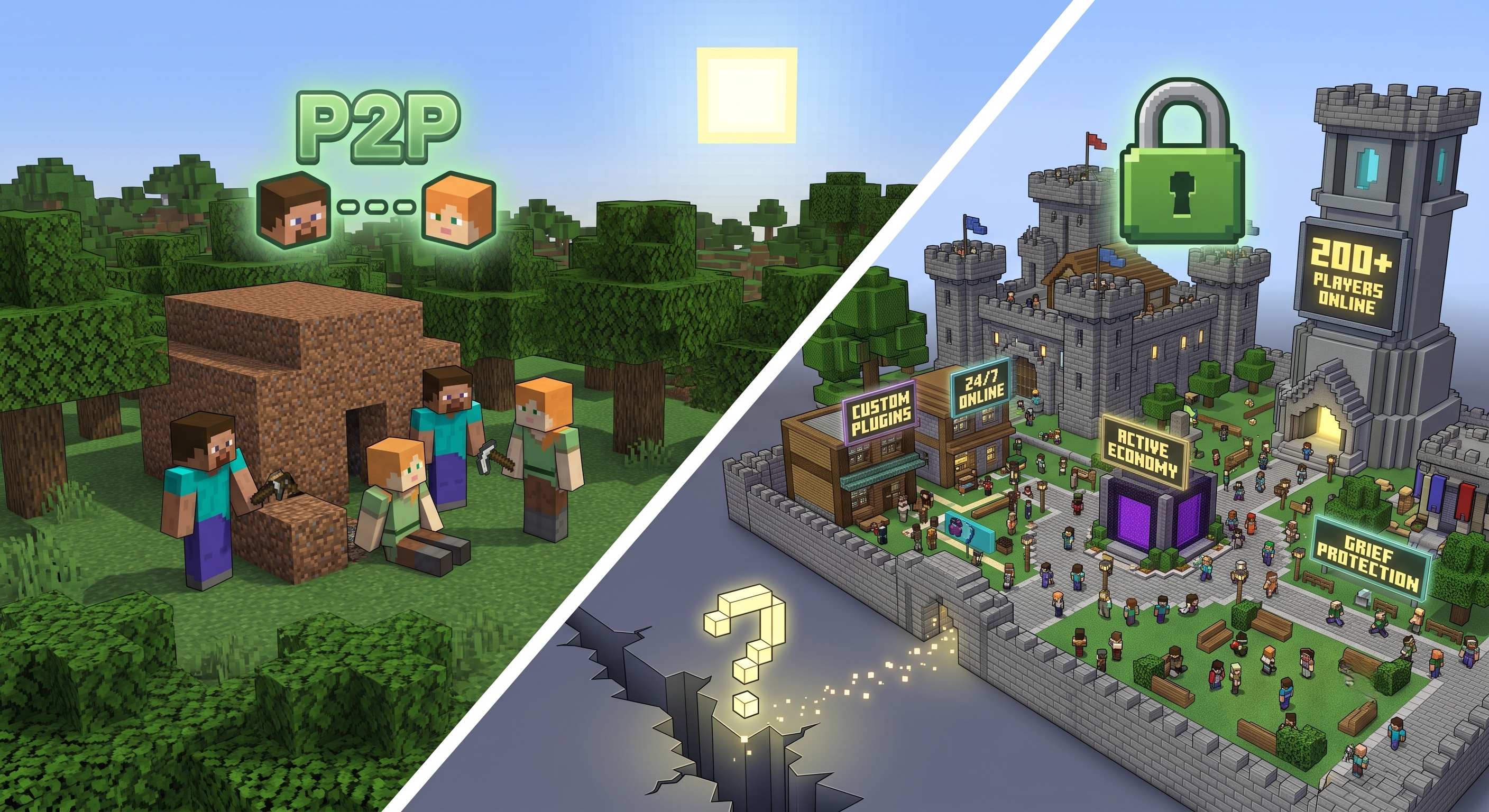
After 17 long years, Mojang finally added a native Friends List to Java Edition. With the latest snapshot, it's now possible to open a singleplayer world to friends online, with no additional Realms subscription or third party mod required. It feels like this update is being perceived by some as a threat to traditional servers, and I don't think it is. If you think about who this was really built for, that's immediately apparent.
What the Update Does
Minecraft Java Edition 26.2 Snapshot 7 introduces both a native friends list and native peer-to-peer multiplayer, built on top of the existing system. While Open to LAN still exists, Mojang added a new Multiplayer Options screen that gives you three options alongside Off and Local: Online.
Online is the new kid on the block and allows players to broadcast their singleplayer world and let their friends join from literally anywhere. The Friends List can be found both on the Title Screen and the Pause menu, and shows the following statuses: Offline, Online, In a World, and In a Joinable World.
The key detail here is that it's peer-to-peer: you are the server. This only affects the world you are currently in, and when you close your game, so does everyone else connected.
And this last point is the core of the whole argument.
Public Minecraft Servers Shouldn't Panic.
Public Minecraft servers aren't about access to a world; they're about an experience. Specifically, they sell a 24/7 experience. And this is the whole distinction.
SMP communities, minigame networks, faction servers all run as persistent, non-stopping platforms with custom plugins, economies, staff, and player communities that have been in place for years. If a player logs in at 2 AM, the world is there, their base is there, their inventory and progress is still there, and the economy kept churning while they slept.
Peer-to-peer multiplayer cannot replicate this.
The world goes offline when you do. Close your game, and everyone you're playing with is instantly disconnected. This is a structural problem with peer-to-peer that makes it unsuitable for anyone who desires the experience of a proper server. Persistence is the product; a session that disappears the moment the host closes their laptop is fundamentally different to a server that has been running for three years straight.
This doesn't scale. Mojang hasn't put any hard player limits in their snapshot 7 patch notes, but there will be a limit, and that limit is primarily determined by your home upload speed and the power of your computer. Dozens and even hundreds of players at once are handled by multi-node, professional server infrastructure. Home setups cannot and will never touch this. The system is designed for small groups of friends.
There are no custom plugins. Opening to LAN, and the new native online feature, opens up a vanilla world. This means no custom mini games, no anti-cheat systems, no player-run economies or towny servers. None of the mechanics that make a public server worth playing on and that defines the concept of a competitive public server. This system will probably support mods soon enough (if it doesn't already), and if not, a mod that makes it so will undoubtedly be made. Mods like Essential have existed for a while, however, and never caused public servers to drop in player numbers, and in any case, private, easy-to-use multiplayer mods haven't traditionally taken people away from the communities.
Who Does This actually Affect
If this update has any negative implications at all, it affects free Minecraft server hosts and players who used these free servers simply to play with a few friends. Players in this segment now have a virtually zero-friction, in-game solution readily available. This is a disruption to the experience offered by those specific servers.
If the peer-to-peer system allows mods, then Essential will also likely be directly affected. Its entire appeal was solving this exact problem for Java Edition players, and this system does precisely the same thing. This, in turn, makes the mod largely obsolete. However, as mentioned, Essential never harmed servers.
Traditional public servers have not lost a valuable customer. The player who rented a cheap server or used a free host just to play with a few friends was never a person who would have spent real money on ranks and crate keys on a large-scale 200-player SMP server. These are different players with different motivations, and this change has done nothing to take potential paying customers away from them.
Conclusion
The addition of a Friends List has closed a 17-year gap for many casual players looking to hop into a game with friends without the tedious setup. This is a fantastic addition for what it is.
It, however, does not, in any way, pose a threat to traditional Minecraft servers, due to the fundamental differences in the type of player that is targeted and the nature of public servers themselves. Peer-to-peer multiplayer will never compete with the persistence, scale, and custom gameplay possibilities of a public server, and the players that typically used free hosting for casual friend play have always been distinct from those who frequent established public communities. In fact, this update may actually benefit public servers.
Are you looking for a new public server to play on? You can find one on our server list at SMPFinder.com and join a new community today.
Tags: Minecraft Java Edition, Minecraft Friends List, Minecraft Peer-to-Peer, Minecraft Multiplayer 2026, Minecraft Server News, Chaos Cubed Update